New study in Nature Climate Change on the declines in bumblebee habitat suitability linked to climate change
Published on September 02, 2026, by Bastien De Tandt & Simon Dellicour
Our new study on the declines in European bumblebee habitat suitability attributable to climate change has been published in Nature Climate Change. Climate change is increasingly implicated in the decline of insect pollinator populations, which provide critical ecosystem services. Isolating its contribution from other co-occurring environmental stresses remains challenging yet crucial for informing conservation strategies and mitigating biodiversity losses. In this new study, we isolated the role of climate change by comparing predictions of areas ecologically suitable for European bumblebee species from 1901 to 2019 under factual simulations to predictions under counterfactual climatic conditions where long-term climatic trends were removed. Our results indicate that climate change reduced community-level ecological suitability across Europe by 5% on average and up to 19% locally, with pronounced declines in southern and central regions. In contrast, in the Alpine and Boreal regions, gains at higher altitudes partially offset losses at lower latitudes and altitudes, resulting in minimal net changes. Our results demonstrate that climate change is reshaping the ecologically suitable areas for these key pollinators and represents a pervasive pressure on European wildlife. Read the whole study here.
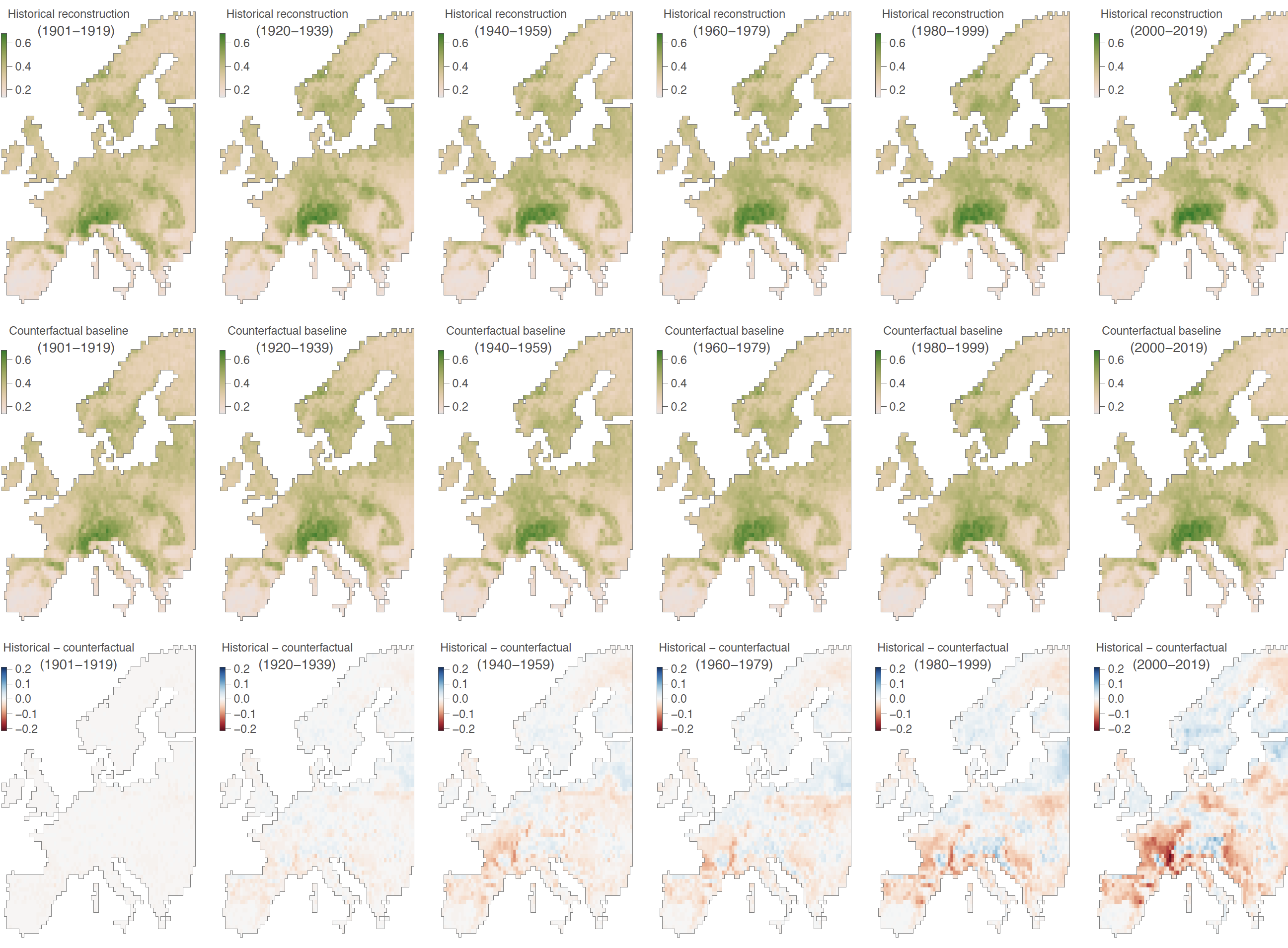 Figure 1. Evaluating the isolated impact of climate change on the European areas ecologically suitable for 47 bumblebee species.
We report, for each period, the difference between bumblebee ecological suitability estimates based on (i) the reconstructions of the historical climate (first row) and (ii) a counterfactual baseline (second row). The third row of maps reports the difference, for each time period, between the two, i.e., between the estimates based on the reconstructions of the historical climate and the counterfactual baseline. We focus on the ecological suitability index (ESI), defined as the local mean ecological suitability averaged over species (ranging from 0 to 1). The computation of the ESI metric was based on species-specific ecological suitability maps, which were obtained by averaging over the estimates of ten independent BRT models trained on present-day data retrieved from the ISIMIP3a reanalysis dataset GSWP3-W5E5. See Extended Data Figures 3-5 for the corresponding results based on the three other ISIMIP3a reanalysis datasets — 20CRv3, 20CRv3-ERA5, and 20CRv3-W5E5 — considered in the present study.
Figure 1. Evaluating the isolated impact of climate change on the European areas ecologically suitable for 47 bumblebee species.
We report, for each period, the difference between bumblebee ecological suitability estimates based on (i) the reconstructions of the historical climate (first row) and (ii) a counterfactual baseline (second row). The third row of maps reports the difference, for each time period, between the two, i.e., between the estimates based on the reconstructions of the historical climate and the counterfactual baseline. We focus on the ecological suitability index (ESI), defined as the local mean ecological suitability averaged over species (ranging from 0 to 1). The computation of the ESI metric was based on species-specific ecological suitability maps, which were obtained by averaging over the estimates of ten independent BRT models trained on present-day data retrieved from the ISIMIP3a reanalysis dataset GSWP3-W5E5. See Extended Data Figures 3-5 for the corresponding results based on the three other ISIMIP3a reanalysis datasets — 20CRv3, 20CRv3-ERA5, and 20CRv3-W5E5 — considered in the present study.
Reference: De Tandt B, Serres K, Rosa Pietroiusti R, Erazo D, Massonnet F, Michez D, Thiery W, Ghisbain G, Dellicour S (2026). Evaluating the decline of European bumblebee populations attributable to climate change. Nature Climate Change, in press